
The S&P/TSX Composite Index advanced from Q2/2024 resistance putting the index at all-time-highs. Materials (24.73%), Energy (18.61%), Industrials (11.33%), and Financials (7.31%) have contributed to an index return of 9.72% YTD. Relative to the S&P 500, the TSX has continually lagged US equities since Q1/2023, due to our limited exposure in the technologies sector. Financials and Energy account for nearly 50% of the TSX, whereas Information Technologies and Financials represent approximately 45% of the S&P 500.
Various economic and market indicators are giving off mixed signals. But the most important indicator is the market trend itself — we simply don’t fight the tape. Financial markets are not the economy but are considered leading indicators of where investors think the economy will go. The market cycle tends to peak and trough ahead of the economic cycle.
The TSX has continued to post new daily highs and it’s easy to get swayed by the headlines. It’s important to consider the bigger picture going into the second half of 2024 — these are some points to ponder.
The economic cycle influence corporate profit outlooks, which influence investor sentiment, and sentiment influence markets. Canada’s Real GDP increased by 0.4% in Q1/2024 driven by growth in both goods and service producing industries. The Ivey Purchasing Managers Index surged in June indicating optimistic month-to-month economic activities. The Unemployment Rate rose to 6.4% in June, led by an increase in unemployment in the youth category, although the core-age group has remained unchanged. On the gloomier side of things — the Consumer Confidence Index has been on a steady decline since Q2/2021, New Orders have been decreasing since Q2/2022, the Employment Rate (61%) has been in a downtrend since Q2/2023, and Industrial Productions decreased by 0.60 in Q2/2024.
In June, the BoC had decided to cut its overnight rate to 4.75% — its first rate-cut since the pandemic. The decision reverberated across the yield curve and investors observed synchronized declines in 3-months to 30-year bond yields. The 10-year yields (3.35%), an important benchmark for interest rates, fell below its internal 34-period weekly EMA, raising the question — are we observing a peak in yields? Industrials, Energy, and Materials are historically strong performers at the latter stages of the business cycle in inflationary environments. Could this persistence in commodities pause near-term rate-cuts?
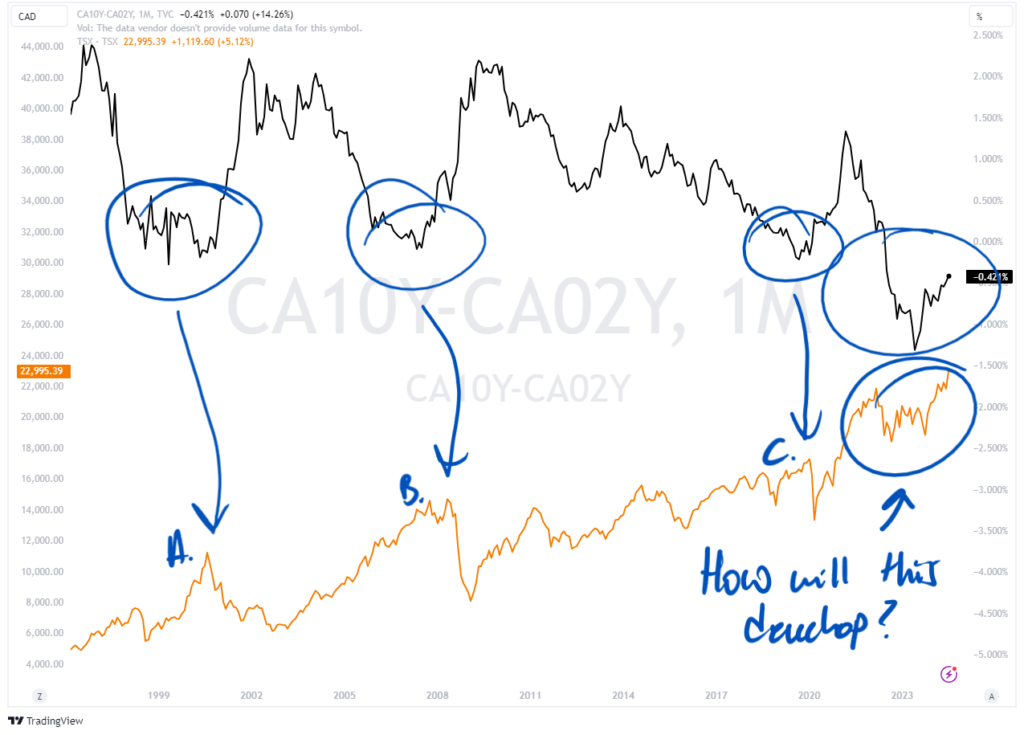
The 10Y-2Y yield curve has been inverted since Q2/2022 and it’s notable that prior inversions preceded the Dot-Com Bubble (A), the Great Financial Crisis (B), and the COVID-19 Pandemic (C), followed by TSX drawdowns of 50%, 50%, and 37% respectively. History doesn’t repeat itself, but it does rhyme — how will this inversion effect financial markets?
The ratio between ‘Technologies/Utilities’ is at an inflection point with a flattening 34 weekly EMA. A resolution in either direction could provide some clarity. A rising ratio, particularly at the early stages of market expansions, favour growth-oriented sectors. In contrast, a descending ratio tends to favour rate-sensitive sectors such as Consumer Staples, Healthcare, Utilities, Financials, and Real Estate. Will we start to observe rotation towards defensive sectors in the coming months?